The paradox of choice is a well-documented phenomenon in consumer psychology: beyond a certain point, more options do not increase satisfaction — they produce decision paralysis and reduce the probability of any choice being made at all. For online gaming platforms operating in India in 2026, this paradox has become a concrete engineering problem. A catalogue of 4,000-plus titles is a competitive asset on paper and a content discovery challenge in practice. Platforms like https://topxbonus.in/ — aggregating over 7,625 slots, 249 crash games and 48 proprietary titles from providers including Pragmatic Play, BGaming, PGSoft, Red Tiger and Yggdrasil — sit at the intersection of that challenge, where the quality of the recommendation infrastructure is as consequential for user retention as the quality of the games themselves.
Why Search Alone Does Not Scale
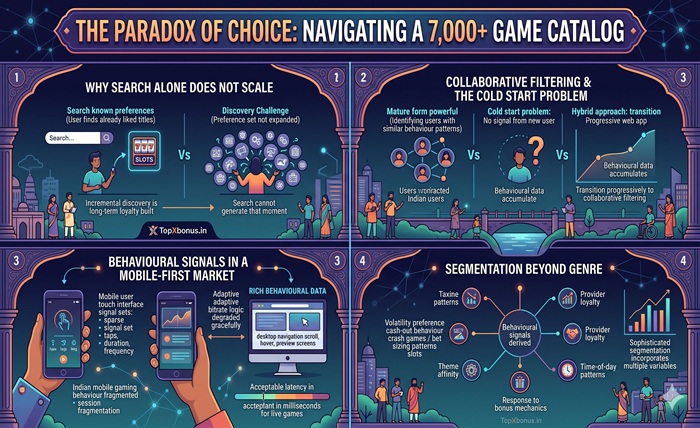
The default solution to content discovery at scale is search. A user who knows what they want types a title name and finds it. The problem is that search optimises for known preferences — it helps users find what they already know they like, but does nothing to expand that preference set or surface content that the user would enjoy but has never encountered.
For a gaming platform, this limitation has direct commercial consequences. A user who discovers three games they enjoy and rotates between them is less engaged and more churn-prone than one who continuously encounters new titles that match their taste profile. The incremental discovery — the moment a user finds a game they did not know existed and immediately adds it to their regular rotation — is where long-term platform loyalty is built. Search cannot generate that moment. Recommendation systems are designed specifically to do so.
Collaborative Filtering and the Cold Start Problem
The dominant algorithmic approach to content recommendation in digital platforms is collaborative filtering: identifying users with similar behaviour patterns and using the preferences of the group to predict what an individual user will enjoy. In its mature form, this approach is powerful — it is the foundation of recommendation systems across streaming, e-commerce and content platforms globally.
For gaming platforms, collaborative filtering faces a specific challenge known as the cold start problem. A new user has no behavioural history. The system has no signal from which to infer preferences, and the user has not yet provided the implicit feedback — time spent, return visits, session depth — that collaborative models rely on. In the critical first sessions, when the risk of early churn is highest, the recommendation engine is operating with the least data available.
The standard engineering response is a hybrid approach: content-based filtering for new users, where game attributes — genre, volatility, theme, provider, session length — are matched against stated or inferred preferences from registration or early behaviour; transitioning progressively toward collaborative filtering as behavioural data accumulates. The transition threshold and the weighting between the two approaches are parameters that require continuous calibration against actual retention outcomes.
Behavioural Signals in a Mobile-First Market
The signal quality available to recommendation systems varies significantly by device and usage context. A desktop user navigating a gaming platform generates rich behavioural data: scroll depth, hover events, time spent on game preview screens, sequence of pages visited before a game launch. A mobile user on a touch interface generates a sparser signal set — taps, session duration, return frequency — that requires different feature engineering to extract comparable inference quality.
India’s gaming audience is overwhelmingly mobile-first, which means recommendation systems built for Indian users need to be designed around mobile-derived signals from the ground up rather than adapted from desktop-optimised architectures. Session fragmentation — the pattern of short, frequent sessions that characterises Indian mobile gaming behaviour — creates additional modelling complexity: a five-minute session may contain enough signal to update a preference model meaningfully, or it may represent an interrupted session that should be treated as continuation rather than independent data.
Segmentation Beyond Genre
The most naive approach to gaming recommendation treats genre as the primary segmentation variable. A user who plays crash games gets recommended more crash games. While directionally correct, this approach misses the within-category variation that actually drives preference. Not all crash games appeal to the same user: some players are attracted by social features, others by multiplier volatility, others by visual theme or session pace.
More sophisticated segmentation incorporates volatility preference — derived from observed cash-out behaviour in crash games or bet sizing patterns in slots — alongside theme affinity, provider loyalty, time-of-day patterns and response to bonus mechanics. A player who consistently exits crash games at low multipliers is expressing a preference for frequency over magnitude that should inform recommendations across all interactive game categories, not just within crash titles specifically.
The Infrastructure Behind Real-Time Personalisation
Delivering personalised recommendations in real time — updating the featured game carousel as a user moves through a session, adjusting the homepage layout on return visits, modifying promotional offers based on current session context — requires infrastructure that operates with low latency at scale. The recommendation computation cannot block the page render; it must complete within the time budget of a normal page load on a mid-range Android device on a 4G connection.
In practice this means maintaining pre-computed recommendation sets that are updated asynchronously between sessions, with a real-time override layer for high-signal contextual events — a user who just completed five crash game sessions in a row should see crash-adjacent content surfaced immediately, not after the next scheduled batch update. Balancing pre-computation efficiency against real-time responsiveness is one of the less visible but more consequential infrastructure decisions in modern gaming platform architecture, and in India’s mobile-first, high-volume market, getting it right is what separates platforms that retain users from those that merely acquire them.