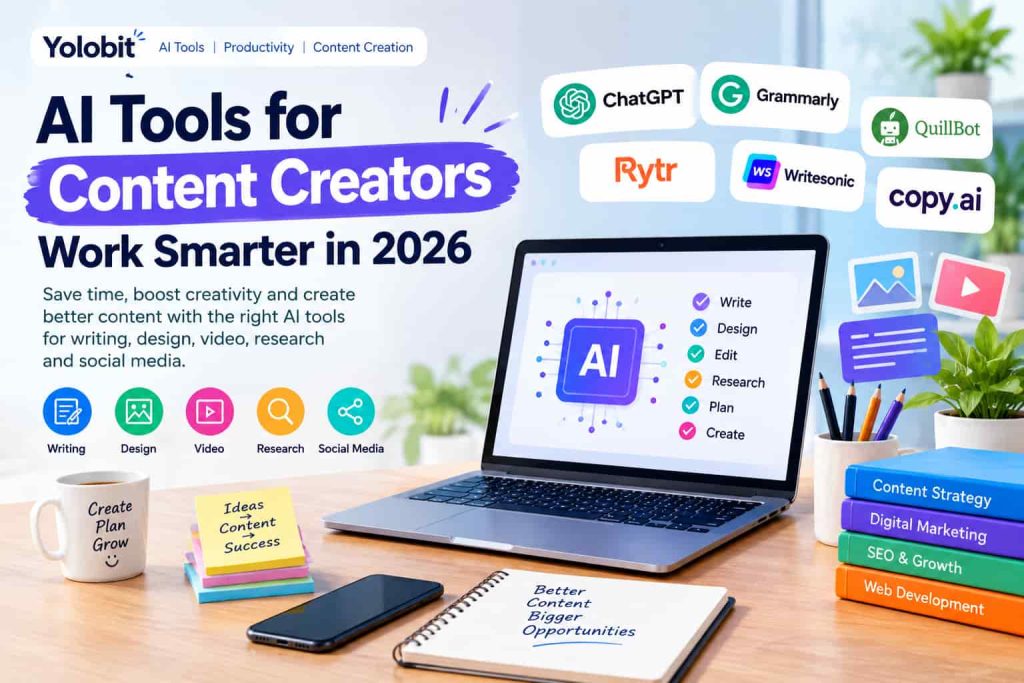
Wish to learn how AI tools for content creators simplify writing, design, video, research, and social media tasks while helping creators save time and stay consistent. Want to create high-quality content without spending hours on every task? AI tools for content creators can simplify research, writing, design, editing, and content planning from one workflow.
AI Tools for Content Creators
Things have evolved significantly in recent years in the area of content creation. No longer need to write software, simple design programs or manually edit. In the present scenario, Artificial Intelligence can assist with nearly all the content creation process. The idea behind AI for content creators is to minimize repetitive tasks and enable individuals to produce the content they need more efficiently. They can help with ideas, writing, pictures, videos, social media posts, research, editing and even planning the content. It’s not about creating everything with AI. Rather, these tools can be used to accomplish otherwise time-consuming tasks without losing control of their ideas, voice, creativity and final decisions.
Why Creators Are Using AI More Often
It can be challenging to produce content regularly when working alone or as part of a small team. One blog post can take some research, planning, writing, editing, images, SEO optimization and promotion. AI can assist in the organization of these tasks and minimize the manual workload. A creator, for instance, might have a general concept and let an AI assistant brainstorm ideas for ideas, draft an outline, come up with possible questions to be answered by the audience, or enhance the organization of an existing draft.
It can be helpful in making the production process more manageable without taking away the human aspect of content production. Another benefit is the speed. With streamlined repetitive tasks, creators can dedicate more of their attention to storytelling, originality, engagement with their audience, and creating new concepts.
Key Features of AI Content Creation Tools
The services offered vary from one platform to another, but many of the latest applications offer a variety of useful services in a single location. AI can provide content outline, headlines, captions, and introductions; product descriptions; and draft content. These capabilities are especially helpful for content creators who are required to create content on a variety of platforms.
Research support: There are some tools that can organise information, summarise, and aid in topic exploration.
Image generation: Artists can generate images from text prompts, such as concepts, sketches, thumbnails, and more.
Video assistance: AI can help with video editing, subtitles, scripts, voiceovers, and the creation of short-form content.
Content optimization: some platforms will assist you in optimizing content for readability, keyword, titles, and social media copy.
Idea generation: AI can generate ideas on content topics, a specific audience, industry or even a content format.
AI for blogging and writing
One of the most prevalent use cases for AI in creation is writing. One of the most frequent use cases is writing, which is the area where creators turn to AI. AI writing assistants offer support in making a concept into a structured draft. A blogger could give a subject and request what heading, questions to be answered or other perspectives might be used for the article. The creator can also utilize AI to recognize sentences that are unclear, enhance transitions, or simplify complex language after drafting a document.
But AI-generated writing requires human editing. Content that is generic, inaccurate, repetitive or lacking in personal experience may not be as valuable. Creators should therefore consider using AI-generated content as a foundation and not as a means to publish every piece of content it generates. Incorporating personal anecdotes, opinions, expertise, and information that is accurate and pertinent will enhance the final product.
Visual Content and Graphic Design
Images are key to any website and social media. Handcrafting graphics can be time-consuming, especially for those who have to produce multiple versions of the same graphic. AI design tools can assist in concept generation, background removal, layout building, resizing images, and generating image variations. It may be useful for creating images for social media posts, blog images, Thumbnails, ads, presentations, and promotional materials. AI can also be used in conjunction with traditional design software to help creators come up with ideas. This enables them to automate the repetitive tasks and have control of typography, branding, composition, and visual identity.
AI-Powered Video Creation
There are several stages to the production of video content, such as scripting, recording, editing, captioning, and publishing. Many of these activities can be aided by AI. Some examples of this include transforming a lengthy video into shorter segments, transcribing videos into text, editing out unwanted portions of a video, writing scripts, or generating voiceovers. Some platforms will also be able to assist with arranging footage and pinpointing any sections that might be beneficial.
If you’re a creator, this is particularly important if you share content on video platforms like YouTube, Instagram, TikTok, Facebook, or others. Automated editing is still a tool to be used at the discretion of the creator. The final video should convey the same message, brand style and intended audience; it shouldn’t just repeat suggestions from the automatic suggestions.
Social Media Content and Planning
Having multiple social media profiles can be a full-time job. Creators must think of concepts, write captions, make pictures, time posts and analyse feedback. AI can help streamline the planning process, by producing content ideas for various platforms and transforming one idea into various formats. For instance, one blog topic might be a LinkedIn post, Instagram caption, short video script or e-mail topic.
This can be helpful for creators looking to keep their social media content consistent across different platforms, without having to create content from scratch for each one. However, the content on social media shouldn’t sound robotic. Creative tone, length, visuals and messaging must be adjusted depending on the platform for each audience.
Selecting the Proper AI Tool
No AI platform is one-size-fits-all. The choice will depend on the kind of content being created and the process of creating it. A blogger could need help with writing and researching content, whereas a YouTube video creator might be more concerned with video editing, captions and audio. Content planning and design can be the focus of a social media manager.
When selecting a platform, take into account features, usability, output quality, privacy options, existing tool compatibility, and pricing. A little experimenting may also show which process seems to come more naturally. Creators should also research how a platform treats uploaded content and personal information, particularly when using the platform to produce content for a client or an unpublished project.
How AI Can Improve the Creative Workflow
The advantage of using AI could be in optimizing the workflow process, not necessarily creating content. Automation can help creators to navigate repetitive phases with greater efficiency and focus on creative decisions. For example, brainstorming, outlining, writing the first draft, editing, making images, and then adapting the final idea to various platforms. The following is a typical working procedure:
- Begin with a human-generated idea and determine the audience.
- Brainstorm, organize or develop the concept using AI.
- Carefully read and modify the material created.
- Include original information, examples, visuals and personal expertise.
- Verify facts, quality, brand consistency and presentation prior to publication.
The Importance of Human Creativity
AI can produce content quickly, but speed does not automatically equal quality. The strongest content still depends on understanding the audience, communicating a clear message, and offering something meaningful. Content that demands personal experiences, fresh storytelling, expert opinion, humor, or a distinct brand voice is particularly valuable to humanize. Creators must therefore think of AI as a tool that can help them and not take the place of creativity. Many tasks are repetitive that can be done using the technology, but humans have to make decisions on what tasks to create technologies for and publish.
Conclusion
AI Content Tools for Content Creators have become valuable assets in today’s creative process. They can assist with writing, research, graphic design, video creating, social media planning, editing and more, which traditionally takes a lot of time. The best solution is a mix of AI efficiency and human creativity and scrutiny. With these tools in place, creators can save time on repetitive tasks and focus more on generating fresh content ideas, refining their content, and engaging their audience.
FAQs
What are AI tools for content creators?
They are software platforms that use artificial intelligence to help with tasks such as writing, research, design, video editing, content planning, and social media creation.
Can AI create content completely on its own?
AI can generate drafts and creative material, but human review is important for accuracy, originality, tone, and quality before the content is published.
Are AI tools useful for social media creators?
Yes. They can help generate ideas, write captions, create visuals, repurpose content, produce scripts, and organize social media workflows.
Can AI help bloggers save time?
Yes. AI can assist with brainstorming, outlines, first drafts, editing, summaries, and content organization, allowing bloggers to spend more time on research and original ideas.
What should creators consider before using an AI tool?
Creators should consider the tool’s features, output quality, pricing, privacy policies, ease of use, and how well it fits their existing content creation workflow.